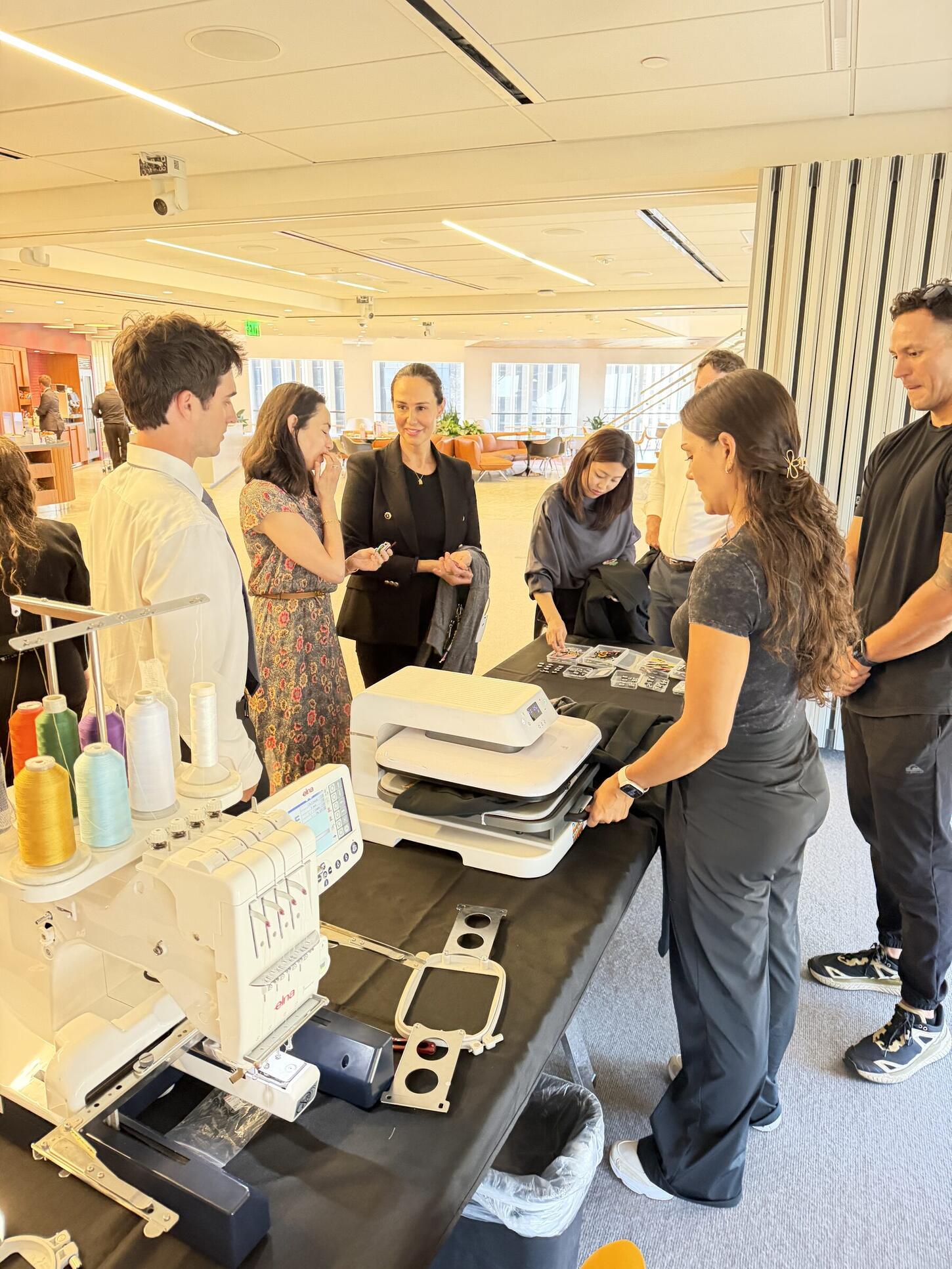
Jersey Bars as Sports Sponsorship Activations
A jersey bar is one of the few booth mechanics where the giveaway keeps working long after the event ends.
Sponsors are not buying jerseys. They are buying the eight minutes a fan spends choosing a name, the mirror photo that follows, and the fact that the garment goes home and gets worn again in October. A jersey bar for corporate sports sponsorship activations is one of the very few booth mechanics where the giveaway keeps earning impressions after the tent comes down.
It is also easy to get wrong, usually in a legal meeting two weeks before load-in. Here is what to settle first.
What the sponsor is actually paying for
A swag table transaction is about eight seconds long. A jersey bar is a three to eight minute engagement plus queue time, and the queue itself becomes part of the footprint — a visible line reads as demand to everyone walking past.
Frame the internal ask in those terms. Dwell time, branded photo capture, and take-home wear rate are sponsorship metrics, and they justify a sponsorship line item. A staffed local package starts around $5,000, with a flat travel fee outside Orange County, LA and San Diego. Presented as a promotional-item purchase, that number looks large. Presented next to what a booth graphic package or a four-hour talent appearance costs, it looks ordinary. Our page on pricing lays out what is bundled in.
The trademark problem nobody budgets for
You cannot print professional team marks, league logos, player names, or college marks without a license. This is the single most common thing that detonates a jersey activation late, and it detonates late because nobody asks until artwork review.
What you can safely build with:
- The guest’s own name and number. Unrestricted, and honestly the better product.
- Your own brand marks. You own them.
- Sport typography and color blocking. Team colors are not trademarks. A green and gold jersey with athletic block numerals evokes plenty without touching a protected mark.
- City and neighborhood wordmarks — carefully. Some are team-owned, some are not. Check each one rather than assuming.
If the sponsorship is with the team or league, get mark usage in writing before artwork locks: which specific files, which placements, which garment colors, and who signs the proof. Player names and numbers are a separate right from team marks, and college athlete names bring their own NIL considerations. When it is ambiguous, sell the fan’s name. Our guide to picking a jersey name and number is essentially a rights-free engagement engine.
Where the sponsor mark goes
The back nameplate belongs to the guest. Always. The instinct to put a sponsor across the shoulders is the instinct that turns a garment people wear into a garment people fold.
Placements that survive the drive home:
- Left chest, two to three inches. Reads in every photo, disappears into the design.
- Sleeve cap. Authentic to real kits, visible in a crowd shot.
- Front center block. If you can get it, this is the best of the three — a chest sponsor styled like a real soccer kit reads as authentic rather than promotional, and people wear it deliberately.
- Lower back hem. Subtle, and it clears the nameplate.
One lockup, one placement. Two sponsor marks on a jersey is the fastest way to make it look like a giveaway.
Queue math before you promise a number
A heat-press station finishes 60 to 90 pieces an hour on straightforward single-hit work. Name and number jerseys run slower, because you are aligning multiple elements per garment and cutting a unique name for every guest. Plan 40 to 60 an hour per station and you will not be embarrassed.
Two stations, four-hour window: somewhere between 320 and 480 jerseys at the top end. Blanks are the real constraint, not the press, so order roughly 1.05 to 1.15 pieces per expected redemption — not per attendee. The two numbers are very different at a 20,000-person event.
Which raises the gating question, and you should answer it early. If attendance dwarfs your capacity, gate the offer: badge tier, a scanned ticket, a contest, a scavenger hunt endpoint, or hourly release windows. Gating is how a station serves a big crowd without a line that becomes the story. It also makes the activation feel earned, which sponsors like more than they expect to.
Data without stalling the line
One field beats five. Ask only for what your team will actually work, because every extra field is measurable seconds multiplied by hundreds of guests.
Put the capture at the front of the line on a tablet, not at the counter. The counter is where the press is and where a guest is deciding what name to put on their back; that is the worst possible moment to hand them a form. Have the form print the order ticket, so lead capture and queue management become the same system rather than two.
Then give a claim number and a pickup time. Letting guests leave the line and come back turns a forty-person queue into a wandering crowd that keeps engaging with the rest of your footprint. Do not require an app download for any of it — the drop-off is brutal and it is the moment people decide the whole thing is not worth it.
If you are still choosing a format, our comparison of a jersey bar versus a hat bar is a useful gut check on dwell time and cost per guest. Crews have run this style of activation for brands including Riot Games and Hyundai, and the pattern holds across categories: the more personal the garment, the longer it lives.
Frequently asked questions
Can we put a pro or college team logo on the jerseys?
Not without a license from the league, team or school. If your sponsorship is with the rights holder, get written approval for the specific files and placements before artwork locks, roughly ten business days out. Otherwise build around the fan name and number and your own marks.
How many jerseys will one station produce in an activation window?
Plan on 40 to 60 finished jerseys an hour per station for name and number work, which runs slower than a single-hit tee. Two stations across a four hour window lands you in the 300 to 450 range. Stock about 1.05 to 1.15 blanks per expected redemption.
Where should the sponsor logo go?
Left chest, sleeve cap, or a front center block styled like a real kit sponsor. Leave the back nameplate for the guest name. A jersey with a sponsor across the shoulders gets worn once; a jersey with your own name on it gets worn all season.
Bring us in at the deck stage
The earlier we see the sponsorship deck, the more of the rights and throughput problems get solved on paper instead of on site. Typical booking runway is four to eight weeks, with artwork locked about ten business days out. Call (562) 614-4800 or tell us about your activation and we will come back with station counts and a realistic redemption number.