Running a jersey bar around a soccer match
A soccer watch party is the easiest crowd in this business and the least forgiving schedule. The match decides when your counter is busy, and the match does not care what your run of show says.
Most events let you choose the busy hour. A watch party does not. Ninety minutes of football plus stoppage is a fixed grid, everyone in the room is watching the same clock, and a jersey bar either fits inside that grid or it spends the evening printing to nobody. The good news is that the grid is completely predictable, so you can plan against it down to the quarter hour.
The grid you are actually planning against
- Doors to kickoff. Your event. Almost everything the counter produces will come out of this window, and the last twenty minutes of it are the single busiest stretch of the night.
- First half. Dead. Anyone in your queue during play is a person who would rather be somewhere else, and they know it.
- Half time. Fifteen minutes, and the room empties towards the bathrooms and the drinks bar before it comes to you. Treat it as a short second rush, not a second event.
- Second half. Dead again, with a slow trickle of people who have given up on the scoreline.
- Full time. Everyone leaves at once. A counter still open here is a counter nobody uses.
Open with the doors, not with the party
The instinct is to open the counter once the room fills. That concentrates demand into the exact window that is already your peak. Open the moment doors open instead, even if the room is thin, and you pull an hour of production out of dead time. Early arrivals are also your best guests to serve first — they are unhurried, they choose better names, and every one of them is walking advertising for the next two hours.
What a crew can genuinely do in fifteen minutes
Be realistic about half time. Fifteen minutes with two lanes is a modest number of jerseys, and a queue that is still forty deep when the whistle goes for the second half will empty itself back towards the screen. If half time matters to your plan, the answer is more lanes for that window rather than a longer window, because the window is not yours to lengthen.
The alternative is the text-when-ready option on premium tiers: a guest hands over a number at half time, watches the second half, and collects on a message. It converts an impossible fifteen minutes into a comfortable forty-five.
Two kits, one room
Stock two blank colours and put them at opposite ends of the rack. At a derby night the room divides itself in the first ten minutes and the photographs stop looking like a party and start looking like a stand. Keep the two colours far enough apart in tone that they read across a dim room — two similar mid-tones photograph as one crowd and waste the whole effect.
Cap the sizes per colour, not just overall. One side exhausting the mediums while the other has a full rack is a specific and very avoidable way to annoy half your guests.
Sightlines are the whole placement question
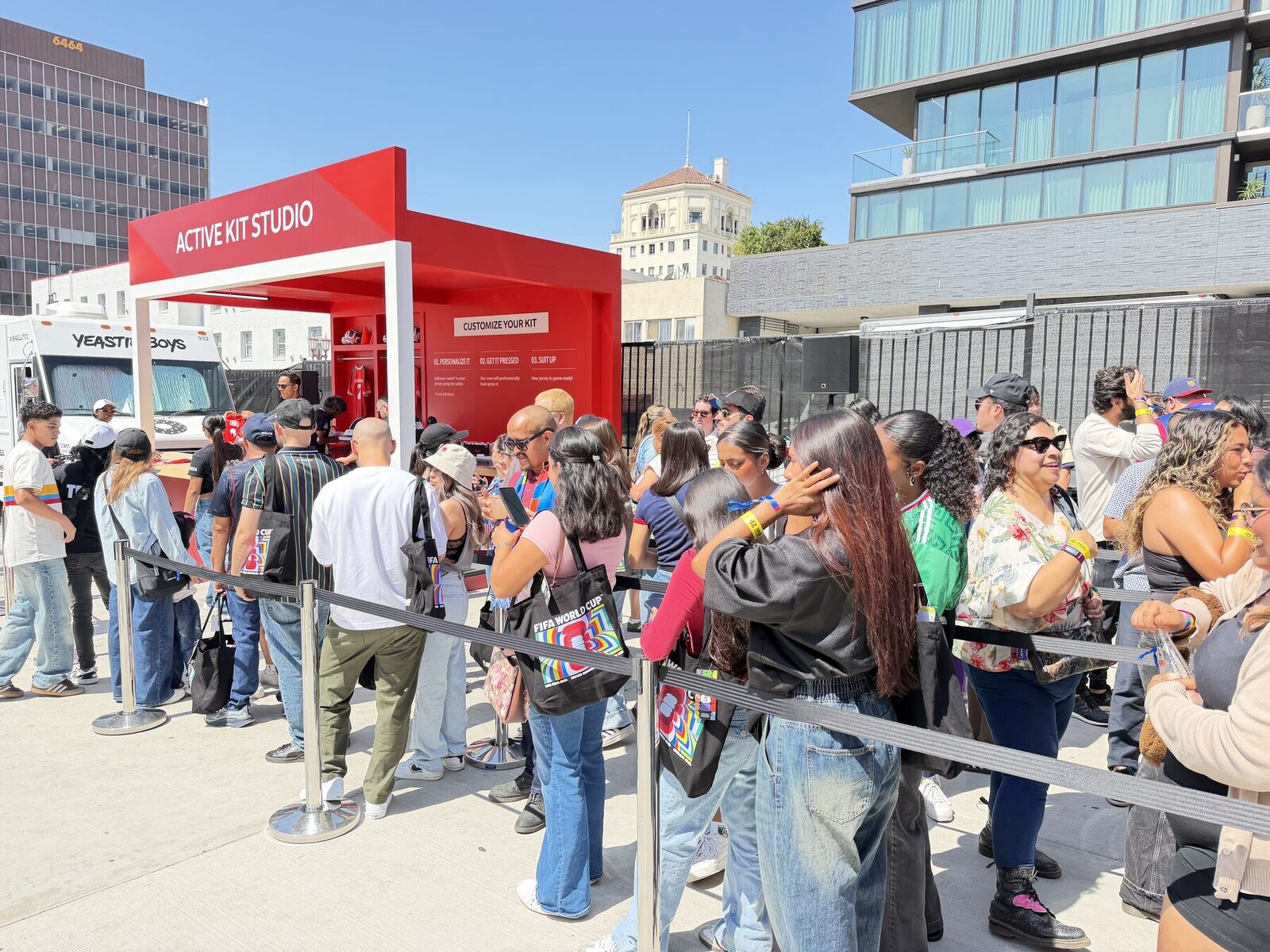
Nobody gives up a view of the screen to stand in a line facing a wall. Site the counter so the queue keeps the match in frame and queue length stops mattering, because standing in it costs the guest nothing. Get this wrong and no amount of lane capacity saves the activation. There is more on footprint and placement on our watch parties and fan zones page.
Multi-match days
A venue running three kickoffs in a day gets the pattern three times, and the three peaks are rarely the same size. The early match brings a smaller, more committed crowd; the evening match brings the room. Rather than staffing every peak identically, we bias the crew towards the big kickoff and keep a lighter counter open through the middle of the day, which also gives operators a chance to restock between rushes.
What goes on the back
Match crowds barely need prompting. Roughly half put their own name with a number that means something to them, and the rest go for the surname of a player who left years ago, the year of a result they will not stop talking about, or the nickname their group uses. Nine characters and one to three digits is the same constraint a real kit works under, so nothing about the result reads as novelty. If you want ideas for the prompt on your signage, we wrote a whole piece on picking a name and number.
Bring your own kit
Supporters' groups, clubs and leagues often own jerseys already, and personalizing what you have removes the largest line from a quote. Send fabric details ahead so press settings get confirmed on a test piece rather than on your stock in front of a room.